Monday, October 19, 2009

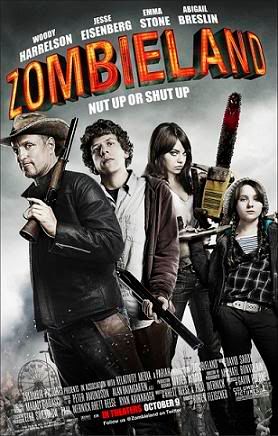
Zombieland


Yet another movie about Zombies, right? WRONG. Everything about this movie should have gone down the wrong way with me: I hate horror, I'm not a huge fan of gratuitous gore, and I'm not especially fond of the undead. But given the cast of tastefully-known but not big name actors, I was curious to see where this movie went.

A movie from director Ruben Fleischer, Zombieland’s premise isn’t exactly original. Most of the world has been stricken by a virus transmitted via biting, and it turns people into zombies, or rabid cannibals with little capacity for reasoning. Columbus (Jesse Eisenberg, Adventureland) is one of the few survivors, due mainly to following an anal-retentive list of rules he never breaks (#1 Cardio, #2 Beware Bathrooms, etc). Trying to make it home to Ohio, he teams up with outlaw zombie-slayer killing machine Tallahassee (Woody Harrelson, No Country for Old Men), and eventually Wichita (Emma Stone, Superbad) and Little Rock (Abigail Breslin, Little Miss Sunshine).

But the clichéd premise doesn’t matter because the execution is brilliant. First things first, Zombieland is hysterical. It certainly knows how to use its grossness for ick-factor moments, but most of the comedy comes from the characters themselves. The cast is a pleasantly star-studded but off the radar group, and the acting is top-notch, with Harrelson stealing the show as lunatic Tallahassee. The comedy is disgusting at times, and appropriately morbid, but never misses the mark; there are even throwbacks to Deliverance and Ghost Busters.

At the same time, there are moments of genuine suspense in the vein of an action film as opposed to a horror film. A heart-thumping confrontation near the film’s conclusion involving heavy weaponry on a roller coaster is possibly one of the craziest shoot-outs ever directed. There are also genuinely heart-warming moments in the film, although towards the end of the film the sap is played up a little too much. The soundtrack is for lovers of indie and classic rock, sporting songs by Sea Wolf, Band of Horses, and Blue Oyster Cult.

The characters are all genuinely likable people and sufficient time is spent on their respective back stories. All around the movie’s a winning combination with a good mix of humor, action, and character development, topped off by stellar direction, cinematography, and clever script-writing. If you can get past the gross factor (or maybe you enjoy it) there’s a genuinely entertaining story here. So yeah, it's all been done before--but rarely this outrageously or awesomely.
-elln

Monday, October 5, 2009

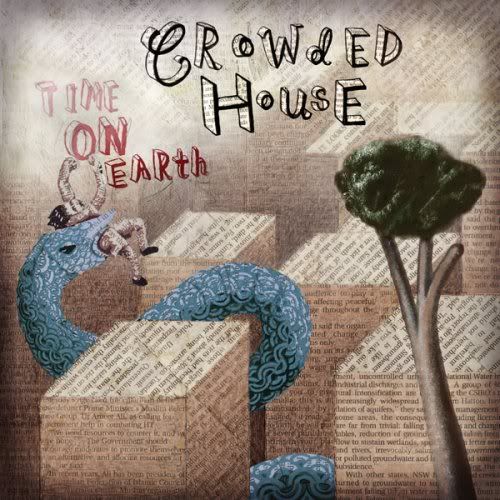
Crowded House's TIME ON EARTH


Power Aussie rockers Crowded House haven't produced anything this good since their streak in the eighties. Time on Earth is a moving piece of work, helped by guests like the incredibly talented, prolific Johnny Marr (fan!) and the Dixie Chicks (not a fan). And it's an album largely haunted by drummer Paul Hester's suicide.

The album's tone is set by the floating, slow, dreamy opener of "Nobody Wants To." Neil Finn's voice is crooning, and while the song is tinged with country it's well-crafted lo-fi rock. Their sound has certainly gotten smoother, slower, and has done away with the new wave/glam tinge altogether. "Don't Stop Now" is simply a continuation of the sleek rock of the album opener, with a sufficiently-built chorus and Finn's distant but simple and piercing vocals. "She Called Up" is the album's first upbeat offering, and it's catchy but not really my style as its country influence is a bit too obvious. The bridge is definitely funky, calling to mind the disjointed chords of bands like Silverchair, but I wouldn't call this an album highlight.

"Say That Again" is another solid offering of melancholy Sunday-morning rock, like a less brash, more sophisticated Goo Goo Dolls. This haunting piece is probably the album's strongest point until the next track, "Pour Le Monde," in which Finn really capitalizes on the piano that was hinted at in the opening track. This piano-driven piece highlights Finn's basic but poetic and touching skill with lyrics, and while the orchestrated backing is this close to being sappy the piece is crafted well enough to avoid that pitfall.

"Even a Child"is Marr's contribution to the album and begins the string of really strong tracks. Integral is Marr's catchy guitar-work; here the country twinge works. "Heaven That I'm Making"is more experimental than prior album songs and isn't the strongest effort on the album; "A Sigh" is a Doves-like lush effort backed by tremoring violins and well-placed orchestral arrangements. "Silent House" (surprisingly co-written by the Dixie Chicks) is an album highlight with a smart buildup to the payoff of a melancholy, gorgeous reflection on a dead friend. Finn even inserts small bagpipe sections, demonstrating that while he knows how to play it safe, he steps outside the box enough to prove his musicianship.

"English Trees" is another album highlight, harking back to the earlier smooth rock at the album's start but even more mellowed out. "Walked Her Way Down" is the jazziest track on the album, with extra points for singable-alongable-ness, while "Transit Lounge" can veritably be called clever in both execution and subject matter, with its self-deprecation and frankness and layering of snippets of language and a nice performance by a female vocalist.

"You Are the One to Make Me Cry" seems to realize that the album is winding down, and builds an air of nostalgia using, once again, violin. Once again, one of the impressive aspects of Finn's work is how easily he incorporates a variety of instruments into his arrangements with ease so that they're effective but unobtrusive. "People Are Like Suns" is almost Keane-ish, with a slow and lovely piano arrangement and haunting, melancholy vocals (which the whole album is shot through with). This is what a good rock album should sound like; it avoids all the cliched pitfalls of the genre. Time on Earth is solid, thought-provoking, simplistic and lovely through-and-through.

-elln

Sunday, October 4, 2009

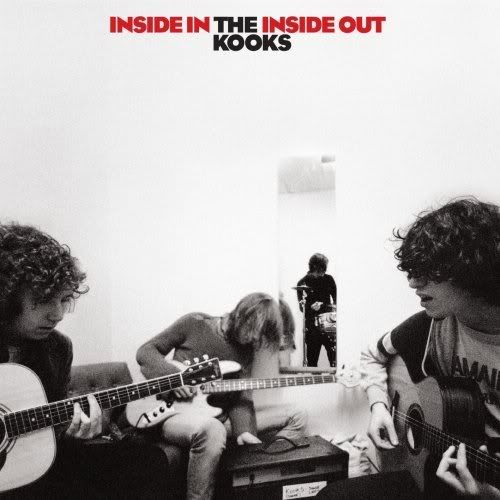
The Kooks' INSIDE IN/INSIDE OUT


It's ironic that the Kooks took their name from a David Bowie song considering how little they have in common with glam rock aside from occasional yowling vocals. No, these English indie rockers have a unique spin on the acoustic and alternative scene which renders their sound distinguishable from the beginning. Inside In/Inside Out is a gem of a first album, and starts out unconventionally with one of the catchiest and lo-fi tunes on the album, "Seaside." A soulful acoustic piece, "Seaside" lasts one minute and forty seconds, and is followed by the song one would think would be the opener, "See the World." The second track is when we first hear the upbeat, buzzy, piercing guitars which are the Kooks' signature from here on out, and while it's not the strongest song on the album, it's a solid start.
"Sofa Song" was released as a single before the album, and sports Luke Pritchard singing in a lower register than we've heard yet before launching into more yowling--albeit controlled yowling. What makes the Kooks so interesting is their raw garage-rock style smoothed over and polished into cystallized indie rock and tight chords. "Sofa Song" starts a slew of singles, and next up is the short and sweet "Eddie's Gun," highlighting the masterful use of harmony which is another Kooks trademark.
"Ooh La" is an album highlight where the Kooks back off on the unrelenting suniness of previous tracks and melancholy pervades this still-catchy, still-commercial song. It's not like the Kooks' subject matter is original, but the way it's written is brilliant enough and relatable enough that, sticking to their style, they really can't go wrong.
There's not much to say about "You Don't Love Me" other than that it's another solid, if not particularly strong, addition to the album. "She Moves in Her Own Way," however, is a nice relief from power-driven guitar hooks and lets the listener breathe at the perfect time with its laid-back approach to a loving relationship and lazy, sunny days.
"Matchbox" marks a lyrical change in the album to the more sophisticated, and shifts musical themes pleasurably, becoming one of the surprise album highlights, especially the catchy refrain. "Naive" is yet another album highlight in the vein of the slightly less raw, more polished second half of the album, while "I Want You Back" returns to direct, less-pleasing lyrics and misses a catchy hook by a hair's breadth. "If Only" is a punk take on alt-rock, short with simple guitar chords but a surprisingly upbeat chorus; "Jackie Big Tits" is a testament to the band's immaturity. The song itself is good, and is a return to the mellow sound of some early tracks, in particular "She Moves"; however, the title (and chorus) is unfortunate and prevents the song from being taken seriously.
"Time Awaits" opens with a markedly bluesy acoustic guitar before launching into traditional Kooks sound--at this point what the album lacks markedly is greater variety in sound; on the other hand, the Kooks have such an enigmatic sound going that the begged question is whether or not experimentation will deliver for fans on following albums. The Kooks end their album quietly, just as they began it. "Got No Love" is as close as the Kooks get to reflective, and it works. For such a fiery first album, the choice to open and close with melancholy tracks is interesting, but it does offer a sense of closure.
-elln

Monday, September 7, 2009

Jane Yolen's THE PIT DRAGON CHRONICLES


I wish Jane Yolen wrote more books like this. In fact, I wish she wrote books like this for an older audience. If you didn't read the first three in your younger years, it might be hard to appreciate her first installment after three decades, and the final book in the quartet (yes, it's a quartet; it was meant to be a trilogy, but Yolen finally concluded the series this year with a fourth book). Dragon's Blood, Heart's Blood, and A Sending of Dragons were all written in the 1980's, and Dragon's Heart was released in 2009.

For young adult books, the politics of Penal Colony planet Austar IV get progressively sophisticated as the series continues. All the books follow the endeavors of Jakkin Stewart, a bonder working on the dragon farm of Master Sarkkhan. As arid and desert-like as Austar is, one of its major industries is dragon breeding for stews, pets, and pit fighting. In Dragon's Blood, Jakkin is unusually ambitious for a bonder, and wants to throw off the yoke of mastery by raising his own dragon; thus, when a brood is miscounted he steals away a baby dragon and begins to raise it on his own in the desert by night. Aiding him is the beautiful and mysterious Akki, the daughter of Sarkkhan; she disappears at the end of the novel, having gone to the City for unknown reasons.

In Heart's Blood, Jakkin has found success with the up-and-coming Heart's Blood, and takes her to several fights in the Rokk Major stadium; he's even won the support of the genial Master Sarkkhan, who appreciates Jakkin's drive and ambition and has given him his freedom. However, he's plunged into a world of dangerous politics when he's sent on a mission to infiltrate a rebel cell to help Akki. A struggle has begun between the ancestors of convicts (anyone with a double k in his or her name) and the wealthy feders, or off-worlders. The story ends with Heart's Blood having given birth to five hatchlings, and tragedy.

A Sending of Dragons is the strangest novel in the bunch, and chronicles the year that Jakkin, Akki, and Heart's Blood's brood spend hiding in the mountains after the disaster at the end of the last book, with their new gift of "sight," or the ability to communicate directly with dragons. They spend much of it fighting the trogs, an ancient race of people who are mute, brutish, and who inhabit the mountain and engage in dragon sacrifice to aquire their mysterious telepathic power. At the end of the novel, Jakkin and Akki are rescued and must return to civilization, hiding their dangerous new gift from everyone.

And finally, after more than ten years, a conclusion.
In Dragon's Heart, Akki makes it her mission to find a way to give everyone dragon sight without dragon slaughter; if the secret is revealed before then, the entire planet's dragon population will be endangered. Meanwhile, both Jakkin and Akki have once again been recruited by Senator Golden, the duplicitous man who had them infiltrate a rebel cell and caused them to unknowingly commit an act of terrorism.

On the whole, these books stand entirely separate from one another. Dragon's Blood is purely adventurous and blood-pumping, while Heart's Blood is the most tragic and confusing. and the end divides childhood and adulthood for both the protagonists. A Sending of Dragons is a surreal survival experience, and seems to take place on a different planet, but it certainly sets things up for the final book in which the reader feels a definite kinship with Jakkin and Akki for all of the strange things they've gone through. Dragon's Heart is the most politically-charged, and wanders into thriller territory at times; in that sense, it's more mature and also slightly disappointing. A return to the brilliant optimisn and straight-forwardness of first love and first fight of book one would have been more welcome. And after the striking realism of all four books, the ending feels empty.

These flaws are minor in the context of four of the best young adult fantasy/sci-fi novels out there. The details of Yolen's world are so simple, but so evocative. The bonder system, a history defined by crime and by names, and political strife all create a vivid world-which is the best part of the series.


-elln

Sunday, September 6, 2009

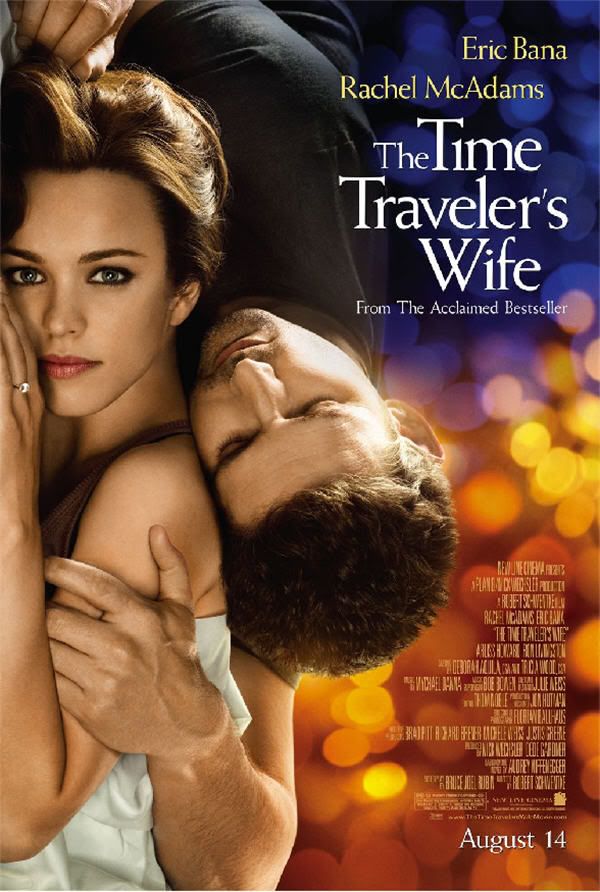
The Time Traveler's Wife (movie)


Henry (Eric Bana) has a genetic disorder which allows him to time travel spontaneously, arriving naked in whatever random destination he might find himself, although more often than not he intersects with his own life. Clare (Rachel McAdams) has been in love with Henry since girlhood, when he visited her from the future. And thus begins the circular question I was asking myself after the movie, and which the movie itself poses--who met whom first? Clare met an older version of Henry as a small girl, but the younger version of Henry meets Clare having no idea that he will meet her in his future, and her past. Thus it is that Clare accuses Henry at one point of having trapped her into loving him because he goes to the past (not on purpose) and imprints himself on her mind when she's a susceptible young girl.

With a brilliant premise, the movie has lots of great moments-and lots of flaws as well, the foremost among them being logic problems. Example: if Henry isn't allowed to interefere with the past, or the future, how is he able to obtain the winning lotto ticket which makes Clare and him millionaires? He can't bring things with him when he travels, so he shouldn't have been able to bring the ticket back with him. The only plausible explanation is that he found out where the ticket was bought, and purchased it in his own time the day of. Which doesn't make sense either because he's not supposed to alter the flow of events. But whatever.

The other major complaint I have is the utterly ridiculous CG caribou. I mean, it was clearly not a real caribou, so it looked really stupid and out of place. Why not just change it to a deer or something, and use a real animal in the filming?

But now on to the good points, which mostly outweigh the bad. The acting-really good (especially from scene-stealers Hailey McCann as Alba DeTamble, and Arliss Howard as Richard DeTamble). The characters-really good. Both leads are enigmatic people, but clearly troubled. McAdams' portrayal of Clare was a little stiff at times, but it did serve to get across her bohemian ice queen image. And while there were narrative problems, most of the logic makes sense when you reflect on it. A word of caution: if you are not a sap and a romantic, you will probably not like this movie. Director Robert Schwentke pours it on almost as thick as The Notebook, and betimes yanks maybe a little too hard on those heartstrings. However, it successfully reiterates the message we all love to believe--that love conquers all, space and time, etc., and in the end it's quite easy to sympathize with the character the movie is titled for--Clare herself. I found it to be a satisfactory romance, drama, and character study with sufficiently-developed characters and lovely cinematography.

-elln

Tuesday, August 25, 2009

Reviews Suck


Our country’s fascination with the prep subculture is ubiquitous and at times unsettling. Shows like Gossip Girl and NYC Prep document the lives of the entitled and the clueless. This phenomenon carries over into books, the literary (?) equivalent of Gossip Girl and the Clique Series (the poor-man’s Gossip Girl) are quite popular as well.

Now enter Everything Sucks. Written in the vein of Prep, Everything Sucks (subtitled: Losing My Mind and Finding Myself in a High School Quest for Cool) denounces prep school life in memoir form.

Hannah Friedman gives us a highly candid look at her life at a New York private school. The daughter of one-hit wonder, Dean Friedman and a monkey-obsessed, paranoid mother, Hannah spends her childhood and preteen years in the shadow of the family’s beloved pet monkey, Amelia. She suffers humiliation at school in the form of bra stuffing gone awry and some unfortunate fashion missteps, such as wearing a bindi to school. Soon, it becomes all too much for Hannah and she enrolls in a private school on scholarship.

Determined to fit in, Hannah makes friends with the In-Crowd, who are called the Great Eight. The Great Eight are like the Plastics, but with a seven (plus) figure trust fund. They could get together with the Heathers for a good game of croquet and could tangle with the aforementioned Plastics any day of the week. Their leader, Cashmere, disregards price tags and throws a fit at her sweet sixteen when given size 6 jeans.

Little by little Hannah becomes acquainted with the intricacies of Queen Bee-dom. She dresses the part, eats as little as possible, and ridicules the less popular. Hannah feels on top of the world for a good while. She enjoys a relationship with Adam, a rich upperclassman who has a bit of a pot problem and a chip on his shoulder. But, soon things begin to spiral out of control. She develops an “overreliance” on Adderall, cocaine, and purging.

Things come to a head for Hannah when college application season comes. The students become even more cutthroat and she writes a cathartic essay that is published in Newsweek about her experience in the application process.

In general, Hannah’s story is something that will be very familiar to many teenage girls, regardless of income or region. It is about one girl’s strong need to fit in with her peers and how far she was willing to go to achieve it. As a teenage girl I found myself cringing with her at the familiar moments of angst and embarrassment. However, there were moments when I wanted to personally tell her that these people were not worth anything that she put herself through.

Despite her fear of freakdom, Hannah Friedman gives us an honest account of how much prep school can suck.


-Acerbec

Friday, July 31, 2009

Elln's Top Ten July '09


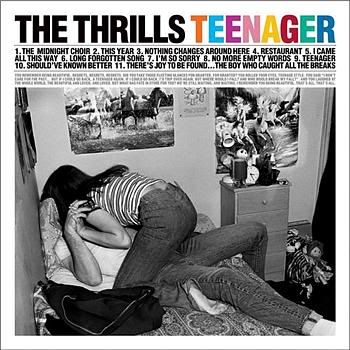
Well, it was tough this week because Dashboard's The Shade of Poison Trees cover is very pleasing to the eye. But I think The Thrill's Teenager cover is so classic, I couldn't resist. So there it is in all its honest, hormone-crazed glory.


1. "Modern Love"/David Bowie-Admittedly, I've never been a huge Bowie fan, but I've been listening to the Adventureland soundtrack a lot lately. His glam rock is powerfully addictive and sort of commercial, while also being musically clever, respectable, and viable. He also incorporates jazz into his rock, evidenced by the saxophones. His lyrics are nonsensical, but somehow make sense. So what I'm saying is that he's essentially a walking, singing paradox. Yeah, I dig those.

2. "Ain't No Rest for the Wicked"/Cage the Elephant-Ah, thank you, something straight-forward. While Cage the Elephant betrays southern roots here with a little country and folk twang, this song is purely mesmerizing rock and roll. The saga-like story-telling lyrics are all folk, but the acoustic guitar hook is 100% clever, polished rock.

3. "Don't Dream It's Over"/Crowded House-Another gem from the Adventureland soundtrack, Crowded House sounds like a band that was an '80's one-hit-wonder, though they actually went platinum in their native Australia for the release of their fifth album, Time on Earth. The song is relaxed with an undeniably mellow, catchy hook, and a sort of melancholy main-stream appeal--like a pared-down, much shallower version of a Smiths song. Which doesn't make it any less good.

4. "The Midnight Choir"/The Thrills-Teenager, Dublin rockers The Thrills' third album, signifies a break from their usual California-inspired classic surfer music love affair to more morose, carefully crafted alternative stuff. While the California guitars are still there, the vocals have become significantly more stylized. "The Midnight Choir" is surprisingly fast-paced for a song playing with nostalgic sadness, but the odd combination works in interesting ways.

5. "Gold Lion"/Yeah Yeah Yeahs-I'll be the first to admit I've never understood the buzz around the Yeah Yeah Yeahs. Perhaps with time my opinion will differ, but for now "Gold Lion" remains my favorite offering of their range of spare garage rock revival offerings. The rawness of Karen O's vocals and the meanness and simplicity of the guitars make the beat of the song easily accessible so that it becomes, almost against the listener's will, addictive.

6. "Our Lips Are Sealed"/The Go-Go's-Another band I'm not such a fan of, the Go-Go's are undeniably one of the quintessential bands of the '80's, and "Our Lips Are Sealed" makes it apparent why. Using clever and direct arrangement and instrumentation, the Go-Go's power-pop sound is well-honed and well-crafted for easy listening.

7. "Swollen Summer"/The Bravery-Okay, it's one of the dumbest songs ever from an album which is stunningly mediocre. But I still love it. I can't really justify it, except that those siren-like guitars and the lyrics "looks like a swollen summer/what if I'm getting dumber?" have wormed their way into my heart over the years. Hey, I'm allowed a guilty pleasure, aren't I? Besides, it's a perfect summer song to obnoxiously blare out the car windows.

8. "Moment"/Gran Bel Fisher-You have to at least give him credit for not singing about love, drugs, depression, or surfing. Instead, GBF sings about being in the moment, and music. So yeah, not terribly original, but not generic, either. This is pretty standard college rock, but it helps that his voice is smoky and rather sexy, and it has a nice southerny tinge to it.

9. "Diamond Hoo Ha Man"/Supergrass-Supergrass is kind of an interesting band; they're classified as alternative, though they kind of steal superficial genre styles from all over the place. Anyway, this strange gem is a catchy song about a thief...who is either personifying his diamonds in an extended metaphor ("I gotta get you in my suitcase"), or is a serial killer putting women in his suitcase after he "love[s] [them] all night long." What I was talking about with the superficiality is that though the guitars are unnaturally heavy and low in the song, the song itself isn't particularly weighty.

10. "Fever Dreams"/Dashboard Confessional-Ah, why can't you put out more delightfully compact pop songs like this, Dashboard? Why do you have to walk the fine line of emodome all the time? This is one of the rare Dashboard songs I actually like, probably because it stays on the acoustic side of things, Chris Carraba manages to sing mostly from the chest and not the nose, and the lyrics are sweet and honest.

-elln