Friday, July 31, 2009

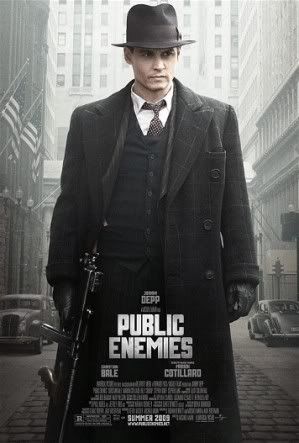
Public Enemies


John Dillinger (Johnny Depp) is America's Most Wanted criminal in the 1930's. A notorious bank robber, his notoriety soon becomes his undoing as crime syndicates begin to see him as a liability and J. Edgar Hoover (Billy Crudup) sends his best agent Melvin Purvis (Christian Bale) in pursuit of Dillinger in a push to establish the FBI.

Enemies is an interesting movie- intense, dark, and racy in atmosphere. Dillinger's fling-turned-love with Billie Frechette (Marion Cotillard) is impulsive and seems poorly developed except that it somehow manages to make its few scenes genuine. Dillinger's character is fascinating. He is portrayed as extremely loyal to friends and family, and he prioritizes public opinion directly after money and Billie. He also totes a gun all the time in the film, but rarely kills anyone, preferring to take hostages over murdering. Speaking of which, on a side note, there is a good one-minute or more spent on a massive gunfight and I've never heard Dolby SurroundSound that loudly. Bad choice on the volume-I was this close to covering my ears.

I'm a Christian Bale fan and he definitely delivered as hard-nosed agent Purvis, blurring the moral lines between the FBI and the criminals they hunt (particularly relevant to the last eight years, eh?). Depp's performance was excellent too- it's always nice to see him outside of his weird roles (such as that awful adaptation of Charlie and the Chocolate Factory). Cotillard was the warmest and most compelling of the bunch, however.

I had two main issues with the film. The first is more minor but nevertheless important: the score. It was inconsistent to the point of eye-rolling when instead of the lovely '30's jazz or folksy bad boy tunes we got sweeping orchestral scores for scenes that didn't really deserve it. Scenes involving Billie were especially susceptible.

The other flaw of the film is that it can't decide (or rather Michael Mann couldn't decide) if it's a hard, gritty take on a real-life infamous public figure, or a throwback to classic gangster movies with all the romanticism and bravado of idealized tragic crime. Still, it makes for an interesting dichotomy, and if you like history, particularly American crime history, and intense character-studies, this is a must-see.

-elln

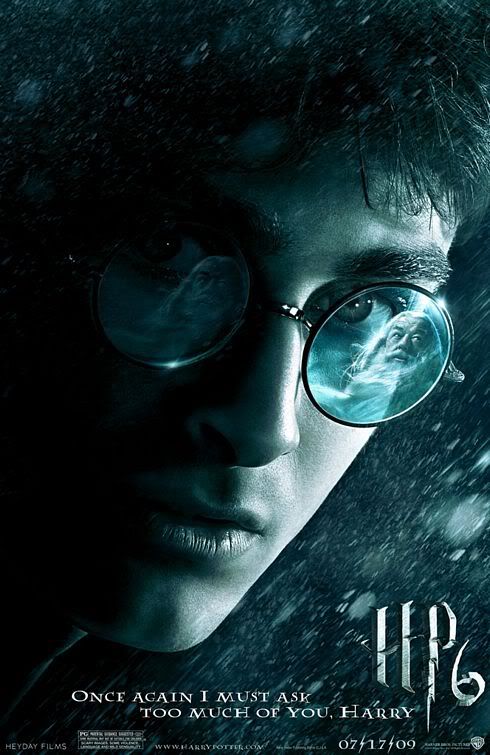
Harry Potter and the Half-Blood Prince (movie)


After the near-travesty of the fourth film and the "business-as-usual" tone of film #5, I went into Half-Blood Prince decidedly apprehensive-and I left it pleasantly surprised.

For those who have been following the movies, a short synopsis: Voldemort has come into the open and Harry is being heralded as The Chosen One. Harry, Hermione, and Ron return to Hogwarts School of Witchcraft and Wizardry amid the chaos of Death Eaters in the open, and Hogwarts is quickly becoming their last oasis. But while hormones are running rampant, Dumbledore has a special mission for Harry: to delve into the past of Tom Riddle a.k.a Lord Voldemort and unravel the secret to defeating him.

I'll first comment on how beautiful the cinematography was. Even book purists shouldn't mind the burrow-burning scene just because of the wheat field film. The arrangment of objects within the frame, the lighting, and the transitions were all spectacular.

On top of that, it helps that the sixth book isn't action-packed until the end. Yates shines as a director when given the time for character development and exploration. Sure, a few key scenes are cut from the plot (most noticeably the Marvolo Gaunt ring backstory, which I expect will be worked into one of the two next films) but the film moves at a much more comfortable pace than its predecessor. It even manages to tackle teenage heart break in a realistic and touching fashion; the Harry Potter movies haven't been this good since The Prisoner of Azkaban. On the other hand the film could have spent less time on Draco Malfoy, and developed the Harry-Ginny relationship past the staring-and-drooling-intensely-at-each-other part. Lastly, I have to say that I miss Richard Harris sorely. Michael Gambon doesn't do it for me.

-elln

Sunday, July 5, 2009

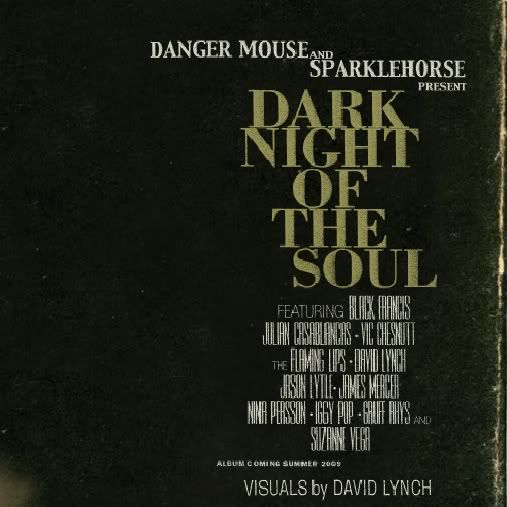
Danger Mouse and Sparklehorse Present: Dark Night of the Soul


Don't go looking for this in stores, kids. It's not legal yet due to a dispute between Brian Burton and record company EMI, so instead Burton & co. have been selling the 100+ page photography narrative done by David Lynch as well as a CD case with a blank CD--subtly encouraging legally questionable downloading of the album.

And what an album it is. I hope they work the deal out because I can't remember the last time I so fell in love with an album. Danger Mouse of Gorillaz and Gnarls Barkley fame has teamed up with lesser-known electro-rocker Sparklehorse and multiple musical powerhouses to create an absolute gem of an album.

We start with "Revenge" featuring The Flaming Lips, and if you've heard anything by the Flaming Lips the bell in the opener of this song gives them away in a second. The song is dark and moody but also laid-back. It's absolutely gorgeous, floating along on a psychadelic wave, building up to smooth and painful choruses and then cresting gently down. "Just War" features Gruff Rhys of Super Furry Animals, with whose work I'm unfamililar. While electronic elements are certainly present, there's a little country thrown in with the rock. Much of the album overall is tough to classify, something I consider to be a true triumph. This is a song which grows on you because of the hook, especially the hard-hitting keyboard; it continues the mellow tone of the album as a whole. "Jaykub" is an odd little animal. It features Jason Lytle of Grandaddy and sports a distinctly folksy sound over the experimental noises in the background.

The cool and collected tone of the album continues with the next track, one of the crowning jewels of the album entitled "Little Girl" and featuring Julian Casablancas of the Strokes. While Casablancas' influence is certainly present, the subject matter is much darker and more sohpisticated than the Strokes' usual fare, which only serves to illustrate the power of the collaboration. I don't know what else to say except that it couldn't really be a more perfect song.

The mellow atmosphere of the album breaks when we get to Black Francis' guest vocals on "Angel's Harp." Again, though, the album seems to have toned things down as the song doesn't really have the same rawness of Pixies songs, nor are Francis' vocals particularly screechy. It's a weird song and will probably please fans but not necessarily the unconverted. In fact, I'd say this song and the next track, "Pain" featuring Iggy Pop, are album weak points. Since it's hard rock and not tightly crafted pop or purist punk, it's a lot tougher to get away with repetitiveness.

David Lynch (who is normally an avant-garde director) holds his own vocally as Danger Mouse and Sparklehorse return to psychedelic meandering dream pop with "Star Eyes (I Can't Catch It)." Jason Lytle returns to sing in the eerie, haunting, regretful "Every Time I'm With You," which is completely different from his earlier appearance on the album. The driving force of the song is a sort of muffled distorted circus tune in the background layered behind a quiet piano and other synth effects. "Insane Lullaby" has an even stranger array of synth, electronic, and occasional orchestral noises. However it features one of my personal favorite guests, James Mercer of The Shins. Unfortunately, no matter how strangely compelling the song is, I'm not sure the music complements his voice quite.

The album goes out of experimental mode and back into a some country swing with Nina Persson of The Cardigan's vocals unobtrusively crooning in the background. "Daddy's Gone" is a sweet, relaxed tune, but not a particularly strong one for the album. "Daddy's Gone" is followed by another of the album's subtly power-packed highlights, "The Man Who Played God." Suzanne Vega sings beautifully for this mellow treat, supported by pretty acoustic guitars. In "Grim Augury" the off-kilter, mournful circus/showtune returns in the background; the vocals are by Vic Chesnutt, another solo artist whose work I'm unfamiliar with. The lyrics are sad and blues-like, and the modernized blues continue in the final track, "Dark Night of the Soul," which sounds like something one of my favorite artists might concoct. The album ends on a lingering, eerie, and distinctly electronic combined with blues/soul note.

This album is short, sweet, low-key, and magnificent.

-elln

Tuesday, June 30, 2009

Elln's Top Ten June '09


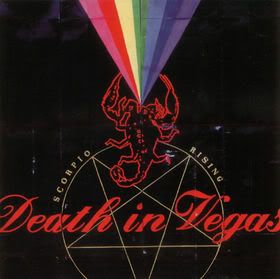
Hands down Death in Vegas' Scorpio Rising cover wins this month.

1. "Amber"/311-Can't say I'm a big fan of the punk-reggae-crossover 311 usually is (which means they failed as a Ska band) but damn this song is real pretty for stoner music. It has an addictive, luscious beat and chill lyrics, if you get my drift. They're also strangely poetic.
2. "There's No Other Way"/Blur-Yay, more '90's British grunge rock, although I often hesitate to put these guys in with Oasis since they're generally more upbeat than the gritty Gallagher brothers. "There's No Other Way" is mellow and laid-back and perfect for summer driving.
3. "Girl"/Beck-Another perfect summer song with Beck's usually cryptic lyrics although the gist of this song is actually understandable-the guy in Beck's song has his eye on a girl and he knows he's going to nail her. This is a pretty classic summer song, low-key and relaxed (when is Beck not low-key and relaxed?).
4. "So You Say You Lost Your Baby"/Death in Vegas-DiV has got to be one of the most eclectic bands I've ever heard, ranging from rootsy rock to weird electronica to grunge rock. "So You Say" is pretty standard rock fare with lyrics and vocals reminiscent of Southern roots rock or even country. It's also mellow summer music-fans of, say, Kings of Leon would probably enjoy this song.
5. "Ramble On"/Led Zeppelin-Before now, I really haven't put much stock in Led Zeppelin. I viewed them as a less talented, less musical version of the Grateful Dead. Plus they technically started the Heavy Metal movement (although if Heavy Metal had stayed the way they played it, I'd have less to complain about). Listening now, though, I can see why they're so addictive. The music has such a wide range of influence and the simple melodies end up pulling you in. I maintain that they're probably more fun to play than to listen to, but I'm thoroughly impressed with the Lord of the Rings references in this song.
6. "Sun Children"/Nickodemus-They're classified as alternative when they really should be world, but Nickodemus produces a solid effort here. "Sun Children" is addictive with a distinct latin flair and actually good rapping.
7. "Karma Police"/Radiohead-This isn't a summer song, but it's still damn good. Reminiscent of a darker, more spare Coldplay, Radiohead will never share Coldplay's widespread commerical success but I think I like them better than Coldplay. It's slow but it doesn't plod in any way, and the piano is the real powerhouse of the song.
8. "Lovers in Japan (Osaka Sun Remix)"/Coldplay-Did I just say something bad about Coldplay? I take it back. "Lovers in Japan," at least this remix, proves once again that they are the masters of universally sweeping, beautiful confections. And don't get the original, get the remix.
9. "Jerk It Out"/The Caesars-Despite the questionable subject matter, the catchiness of this song is unquestionable. The fast tempo in this undeniably alternative, light-weight tune has been featured in numerous commercials.
10. "The Guitar Man"/Cake-A long-time favorite of mine, Cake rarely, if ever, gets this serious. This song is a perfect laid-back melody for summer, complete with light-as-a-feather guitars and infused with melancholy. The best part of the song is the wistful lyrics which are both clever and poignant.

Well that's it for this month. I'll try to keep it a little more upbeat and summery next month.

-elln

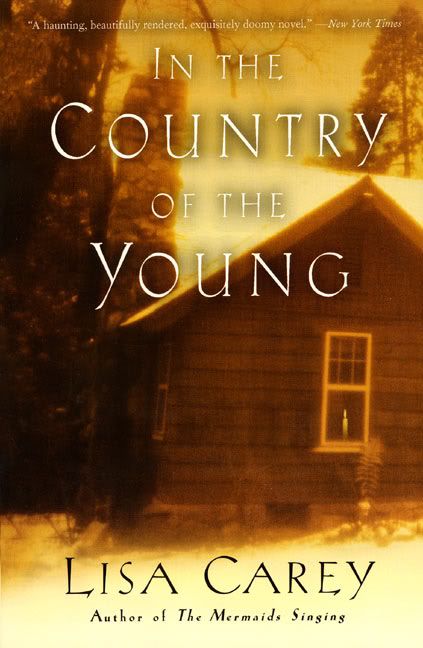
Lisa Carey's IN THE COUNTRY OF THE YOUNG


In the Country of the Young tells the story of Oisin MacDara, an artist who has isolated himself in a tiny Maine community due to horrific tragedy in his childhood, after which he lost the ability to see ghosts. Oisin is enigmatic but lacks social skills because of his hermitage and his unwillingness to interact with other people. It will take the arrival of a ghost from a shipwreck more than one hundred years ago to bring him back to life. And though Aisling isn't the ghost Oisin has waited half his life for, the literally dead and the figuratively dead will both get a second chance at life.

This is the book that makes me believe in ghosts, it's that beautifully written. If you love a good drama, a good romance, and a haunting tale of rebirth and recovery from past scars while at the same time characters drown in the past, then this is the book for you. As always, Carey's writing style is poetic and full of metaphorical language. She weaves dreams and reality, life and death, and intersecting stories together so seamlessly it's tear-inducing. Both the chronicles of Aisling and Oisin, and Oisin and Nieve, are stories to move the heart.

What else, really, is there to say about perfection?

-elln

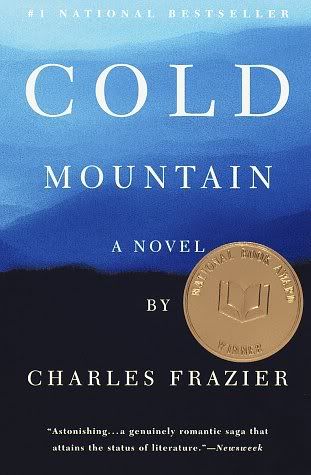
Charles Frazier's COLD MOUNTAIN


Cold Mountain is a lyrical masterpiece, detailing two odysseys with gorgeous metaphors and simple, unembellished language. The story is of Inman and Ada in the Civil War South. Ada is in the Scarlett-esque situation of having fallen from great wealth into poverty with lots of resources. She is owner of a large farm but has no idea how to run it until vagrant Ruby appears, demanding respect in exchange for working on the farm. Inman, her pre-war sweetheart, has deserted the army after a seemingly mortal wound to the neck and a dream convinces him to visit Cold Mountain and return home.

Though Inman's story retains dream-like, almost hallucinogenic qualities narrated by a down-to-earth, disillusioned tone, it is Ada's struggle with the earth which drew me in more. Ada is actually the less likable of the two, but she grows a lot throughout the book and her expectations of life become a lot more realistic.

Perhaps because I knew the ending it didn't pack so much of a punch. The book's main letdown is that it focuses too much on the characters individually, and not on Inman and Ada's pre-war relationship. Maybe the point Frazier is making is that Inman left in the middle of a budding relationship-at the dropping off point between cursory moments and true intimacy. Their parting's awkwardness lends their relationship an insubstantiality, especially when they reunite.

The book's main strength is in Frazier's heart-felt, simple delivery, poignant metaphors, and gorgeous description. I'd read it just for the beauty of the style.

-elln

Sunday, June 28, 2009

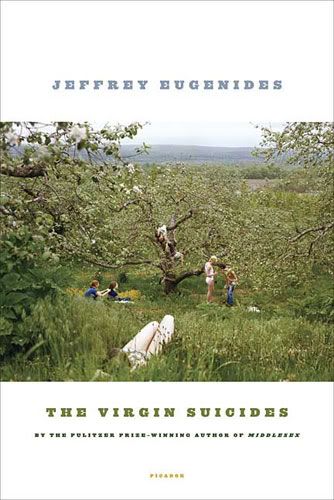
Jeffrey Eugenides' THE VIRGIN SUICIDES


Before I say anything, I'd urge people interested in purchasing the book (or film) to check out all the awesome covers available. The photography and graphics of just about every version of the work are stunning.

Composed of run-on sentences and pieced together in a reporterly manner, The Virgin Suicides is a technical masterpiece. The book tells the story of the Lisbon family living in suburbia, and the suicides of their five daughters Cecelia, Mary, Bonnie, Therese, and Lux. The entire book details the suicides from the viewpoint of the neighborhood boys who are obsessed with the Lisbon sisters as they try unsuccessfully to determine the reasons why the girls took their own lives.

The book makes effective use of rambling description and an investigative manner, piecing together accounts from neighbors, psychologists, and basically any person who came into contact with the Lisbon girls prior to their deaths. The style is what makes the book captivating, however if Jeffrey Eugenides’ goal is to make us fall in love with the Lisbon girls as much as the neighborhood boys are, he fails by a slight margin. The girls are too impersonal, too cold and isolated, and there is no way to sympathize with them; it’s often hard to understand the boys’ obsession with girls who, when they open their mouths, rarely say anything intelligent.

The true satisfaction in reading the book comes in trying to piece together a mystery, but we are told at the end of the book that there is no answer. Surely it’s a true-to-life answer, but a rather disappointing revelation.

The reason the book is captivating to the degree it is is the writing style. Words are juxtaposed in profound manners, paradoxical statements make regular appearances, and the text has a sense of continuous almost stream-of-consciousness feel to it. The novel, while probably meticulously planned, feels fresh and spontaneous. That is its best quality.

-elln